
Design Youth Soccer Brackets That Keep Teams Engaged
Learn how to build youth soccer tournament brackets that reduce blowouts, keep teams playing meaningful games, and make Sunday feel worth it.
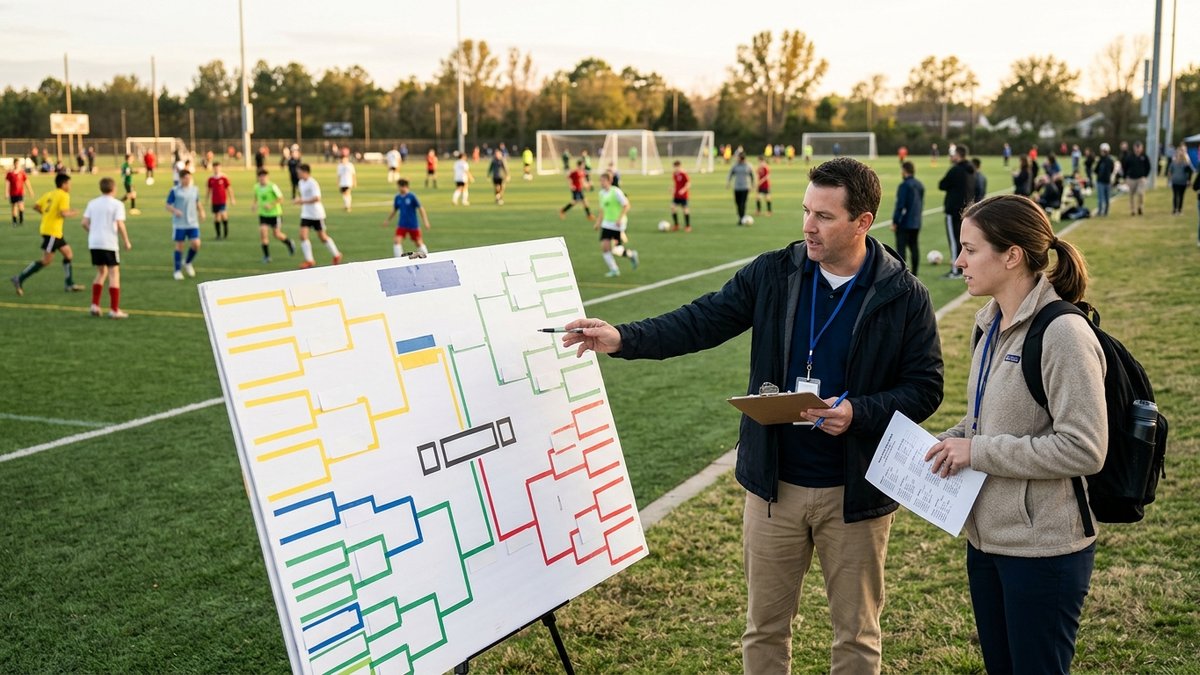
A youth soccer tournament can feel great on Saturday and flat by Sunday if the bracket is doing the wrong job. Coaches notice it fast. One team is clearly overmatched, another is sitting through long breaks, and by the final day half the sidelines are trying to stay positive in games that no longer feel meaningful.
The goal is not to manufacture perfect parity. The goal is to design a weekend where coaches can develop players, parents stay bought in, and teams leave feeling like the event respected their time. That takes more than dropping names into a bracket generator.
Why Do Some Youth Tournament Brackets Fall Apart By Sunday?
They fall apart because too many events sort teams once, too early, then never correct for what the first games reveal. A team can be mis-seeded on paper, crush its pool, and create a Sunday full of predictable matches.
That problem gets worse when a tournament director tries to solve everything with a standard knockout tree. Single elimination is easy to publish, but it creates dead air for teams that lose once and turns the rest of the weekend into either a consolation game or a long wait home. For youth teams, especially younger age groups, that usually feels like a bad trade.
A stronger design starts with one simple principle, I call it the Meaningful Sunday Framework. Every team should have a realistic path to a game on Sunday that still answers a competitive question. Are we competing for gold, for placement, for a balanced crossover result, or for a development benchmark against a similar opponent? If the bracket cannot answer that, teams disengage.
What Bracket Format Keeps More Teams Competitive All Weekend?
Small pool play with crossover matches usually keeps more teams competitive than pure knockout play. It gives you more information before elimination pressure takes over, and it lets you correct mismatches before Sunday.
For many youth soccer events, four-team pools work well because each team gets three games without an overloaded schedule. Pool winners can move into semifinals or championship matches, while second and third place teams can cross into placement games against similar finishers from other pools. That structure creates more honest competition than dropping everyone straight into quarterfinals.
This is also where format choice should reflect age and event goals. If your event is selling development, exposure, and quality matches, pool play plus crossover is usually stronger than a win-or-go-home bracket. If your event is older, elite, and clearly framed around championship stakes, you can use knockout stages, but even then the early sorting still matters. Pitch Planner’s guide to round-robin vs knockout formats is helpful here because the format should match the experience you want coaches to have, not just what fits neatly into a PDF bracket.
How Should You Seed Teams If You Do Not Have Reliable Rankings?
Seed teams with multiple soft signals, not one fake certainty. Past tournament finishes, current league level, coach self-reporting, travel distance, and recent goal differential patterns together are more useful than pretending you have a perfect ranking list.
Most youth tournaments do not have a trustworthy top-to-bottom ranking system across every club entering. That means the real job is to reduce obvious first-round mismatches, not to create mathematically perfect seeds. A simple intake form can help directors ask for division level, recent record, and whether the team should be placed in top, middle, or developmental competition.
You should also be willing to separate teams into flighted brackets once registration closes. Gold, Silver, and Bronze language is common because it gives families a clear signal without sounding punitive. Coaches care much more about getting useful games than about whether the bracket looks elegant.
How Many Games Should A Team Have Before Sunday Placement Is Set?
Three games is a strong minimum before final placement decisions if your schedule allows it. That gives the bracket enough evidence to sort teams more fairly and gives coaches enough time to recover from one poor start.
Two-game samples are noisy, especially in youth soccer where one keeper absence or one early mistake can distort everything. Three games reveal more. You can see whether a team is consistently dominant, consistently struggling, or simply landed in one wild match.
For a weekend event, that often means three pool matches on Saturday or two on Saturday and one early Sunday. After that, placement becomes more credible. If you want Sunday to matter, you need enough data to build pairings that feel earned.
The Best Sunday Structure Is Usually Placement, Not Survival
Placement games create better youth tournament experiences than survival brackets for most teams. They keep more sidelines emotionally invested because the match still means something, even if it is not the championship.
This is where many events miss the obvious fix. A team that finishes second in a strong pool may be better than a team that wins a weak one, yet the bracket often treats those paths as equal or ignores the issue entirely. A placement structure lets you correct for that by matching similar finishers across pools.
For example, first-place teams can play semifinals or a final four. Second-place teams can play for fifth through eighth. Third-place teams can play balanced crossover games. Even fourth-place teams can play a final match that feels competitive instead of ceremonial. That matters to coaches trying to keep a group focused late in the weekend.
If your staff is organizing coaches, managers, and communication across that weekend, clear role ownership matters too. Pitch Planner’s page on coach and manager roles is useful because bracket quality drops fast when nobody knows who is confirming schedules, entering scores, or communicating field changes.
How Do You Reduce Blowouts Without Overcomplicating The Event?
You reduce blowouts by building correction points into the schedule. The easiest ones are pool seeding, flighting, and crossover reassignment after early results.
That does not mean constantly rewriting the entire event in public. It means you choose a format that can absorb what the first few games tell you. If one pool is clearly stronger than another, placement games can fix some of that on Sunday. If a division has an odd number of teams, balanced friendlies or crossover matches can keep the weekend from turning into a bye-heavy mess.
Game spacing matters too. A tired team is more likely to collapse into an ugly scoreline, especially in warm weather or when rosters are thin. U.S. Soccer’s referee and competition guidance consistently treats player safety, rest, and age-appropriate match load as core event responsibilities, not optional nice-to-haves. Tournament design is not just competitive design, it is player welfare design too.
What Should Coaches Actually Look For In A Well-Built Bracket?
Coaches should look for transparency, match purpose, and manageable game flow. If they can tell why they are in a pool, what unlocks Sunday, and how scores affect placement, the bracket is doing its job.
A good bracket also respects the sideline reality coaches live in. They need enough turnaround time to manage subs, recover players, handle parents, and prepare for the next opponent. That becomes much easier when they can track lineups and rotations in one place instead of rebuilding the day between whistles. Pitch Planner’s lineups and formations tools are a strong fit for tournament weekends because they help coaches keep matches organized even when schedules get messy.
The hidden test is emotional, not mathematical. At lunch on Sunday, do most teams still believe the next game matters? If yes, the bracket is working. If no, the structure needs help.
A Simple Build For An Eight-Team Youth Tournament
An eight-team event does not need a complicated format to stay competitive. Two four-team pools, three pool games each, then crossover placement is often enough.
The first-place teams can meet in a championship match. Second-place teams can play for third. Third-place teams can play for fifth. Fourth-place teams can play for seventh. That is not flashy, but it is honest. Every team gets four games, every Sunday game has a clear reason, and the risk of one early mismatch ruining the whole weekend drops a lot.
If you want semifinals instead, you can still use them. Just be careful about what happens to everyone else. The championship path should not come at the expense of making half the field feel like extras in somebody else’s event.
FAQ
Should Youth Soccer Tournaments Use Single Elimination?
Single elimination usually works better for older, clearly elite events than for broad youth tournaments. Most coach-focused weekend events get better engagement from pool play and placement games because more teams stay involved longer.
How Many Teams Should Be In A Pool?
Four-team pools are a strong default because each team can get three matches without an overloaded schedule. Larger pools can work, but they often create uneven rest windows or tiebreak headaches.
How Do You Handle One Very Strong Team In A Balanced Division?
The best fix is to catch it with better seeding or flighting before the event starts. If the mismatch still shows up, crossover placement games can at least keep Sunday from repeating the same blowout pattern.
What Is The Best Way To Break Ties In Pool Play?
Goal differential caps, goals allowed, and head-to-head are common, but the key is publishing the order in advance. Coaches can live with almost any rule if it is clear before the first kickoff.
Why Do Placement Games Matter So Much In Youth Soccer?
Placement games keep development and motivation intact for more teams. Coaches get a useful final match, players stay bought in, and families feel like the weekend was worth the travel.
Can A Tournament Be Too Flexible?
Yes, if teams do not understand the format. The best brackets feel adaptable behind the scenes and simple from the coach’s point of view.
The cleanest youth soccer bracket is not the one that looks most official. It is the one that keeps the most teams competing with purpose through the final whistle on Sunday. Start with smaller pools, build in placement paths, and make sure every team can see what they are playing for before the weekend begins.